Latin America launches a new scientific alliance from Chile to sequence the region’s biodiversity
Over two intensive days, Santiago became the epicenter of biodiversity genomics in Latin America. Researchers, academics and specialists from different countries joined the third 1000 Genomas Chile Workshop, “Biodiversity Speaks Latin,” held on May 27 and 28 at Teatro El Zócalo on Universidad Andrés Bello’s Antonio Varas Campus.
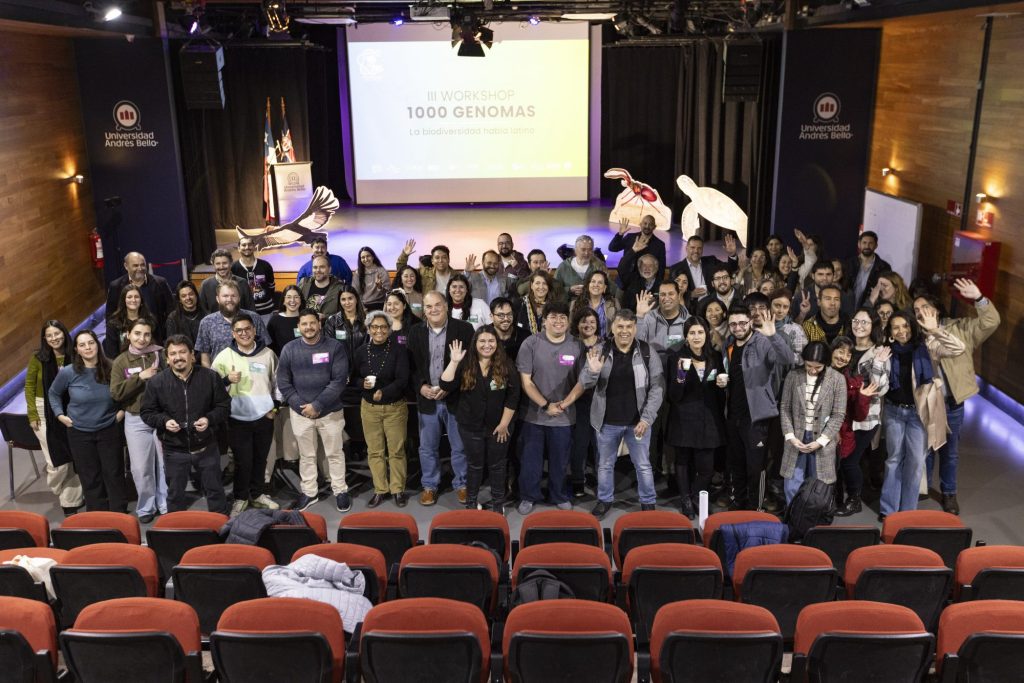
The third 1000 Genomas Chile Workshop brought global genomics leaders to Santiago and launched the Latin American Biodiversity Genomics Network
The meeting attracted international experts from Brazil, the United Kingdom, Germany, the United States and numerous countries across the region, consolidating Chile’s strategic role in developing genomics for biodiversity conservation.
A network connecting science and place
The workshop’s most significant milestone was the official establishment of the Latin American Biodiversity Genomics Network, a collaborative initiative bringing together scientific, technological and human capabilities to study the region’s species through genomics. The network comprises representatives from Chile, Colombia, Argentina, Uruguay, Brazil, Panama and Ecuador.
“This workshop demonstrates that Latin America has the scientific capabilities, human talent and biodiversity to lead genomic research with global impact. Creating this network marks a historic step: for the first time, we are coordinating regional efforts to understand and protect our biodiversity through science conducted in Latin America,” said Dr. Juliana Vianna, national coordinator of 1000 Genomas Chile.*
The alliance is especially significant amid the climate crisis and accelerating species loss, when an independent scientific perspective on the region’s biodiversity has become urgent and indispensable.
Global voices, a regional perspective
International guests included Dr. Alexandre Aleixo of Brazil’s Instituto Tecnológico Vale; Dr. Mark Blaxter of the UK’s Wellcome Sanger Institute, a leading figure in the Earth BioGenome Project; Dr. Camila Mazzoni of Berlin’s Leibniz Institute for Zoo and Wildlife Research; and Dr. Oliver Ryder of the San Diego Zoo Wildlife Alliance in the United States.
The program covered a wide range of topics, from sequencing and bioinformatics to biobanks, governance, education and citizen science. The first day presented progress on the 1000 Genomas Chile Project and formally launched the LATAM Network. The second explored challenges in computational infrastructure, knowledge transfer and advanced specialist training across the region.
Democratizing genomic science
A cross-cutting theme was the need to democratize access to genomic technologies in Latin America, linking science, conservation and international cooperation as pillars of the region’s scientific development.
The initiative forms part of the 1000 Genomas Chile Project, a scientific program seeking to sequence the genomes of one thousand Chilean species, advance biodiversity research and consolidate international collaborative networks to address present and future environmental challenges.
With this new regional alliance, Latin America takes a decisive step toward reading, understanding and protecting its biodiversity through its own scientific voice.