Can extinct species be brought back? The dire wolf and genomics’ role in conservation
Recently, researchers at Colossal Biosciences reproduced some characteristics of the extinct dire wolf (Aenocyon dirus)—the animal made famous by “Game of Thrones”—through genetic modifications to its closest relative, the gray wolf.
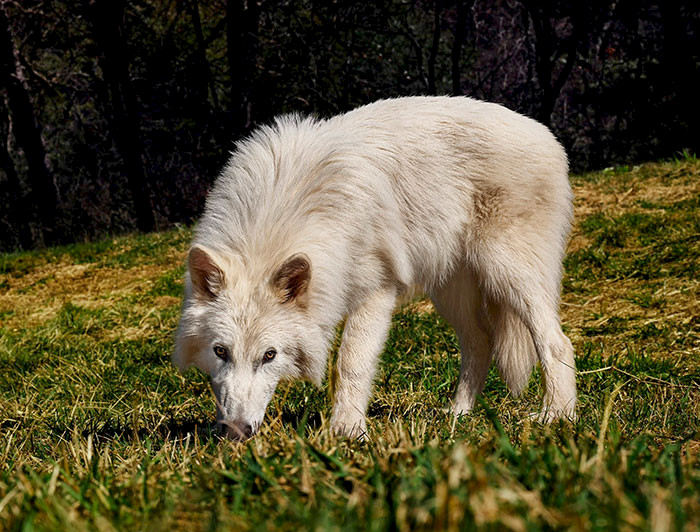
Although this is not a complete “resurrection,” the experiment marks a milestone in using genomic technology to study extinct species and explore new conservation strategies.
The research team identified DNA fragments from the dire wolf, a species that inhabited North America between 2.5 million and 600,000 years ago. Because of its age, the available DNA was highly degraded and fragmented, preventing the recovery of a complete genome. However, using gene-editing technologies such as CRISPR, the scientists made 20 alterations in 14 specific gray wolf genes to reproduce physical characteristics of the extinct wolf, such as coat color and skull shape.
“Having this genetic information is crucial for developing conservation strategies and even genetic adaptations that could help them withstand threats such as emerging diseases or climate change.” — Juliana Vianna, professor at UC’s Faculty of Biological Sciences.
Can an extinct species be “revived”?
Juliana Vianna, a professor at UC’s Faculty of Biological Sciences, evolutionary genomics researcher and national coordinator of the 1000 Genomas project, explains that the experiment does not amount to complete de-extinction. “It is not just about bringing a species back, but understanding whether those characteristics make sense in today’s environment,” she says. She emphasizes that many extinctions result from climate shifts or the emergence of new pathogens, and that any attempt to reproduce ancient traits must consider the species’ ability to adapt to present conditions.
From a more technical perspective, Miguel Allende, an academic in the Department of Biology at Universidad de Chile’s Faculty of Sciences and director of the Millennium Institute Center for Genome Regulation (CRG), says that “in theory, it is possible to bring back an extinct species if its complete genome is recovered and introduced into a compatible cell from a living organism.” In practice, however, this is extremely complex. What was achieved, therefore, was a partial recovery of certain dire wolf traits.

Could this technique be applied to an endangered species?
One of the most important prospects for these technologies is preventing extinction. According to Juliana Vianna, the 1000 Genomas project aims to sequence the DNA of living Chilean species, many of them endemic and threatened. “Having this genetic information is crucial for developing conservation strategies and even genetic adaptations that could help them withstand threats such as emerging diseases or climate change,” she explains.
Miguel Allende adds that with currently available gene-editing tools and the data being generated in Chile, it would be feasible to intervene in local species to increase their resistance to specific threats. Examples include producing genetic variants resistant to viruses such as avian influenza in wild birds, or using these tools to address diseases affecting species such as the Tasmanian devil.
What limitations are there?
The possibility of applying these technologies depends on several factors: the quality of the available genetic material, the existence of related species that could receive the modified DNA, and detailed knowledge of the genes responsible for particular traits. The more recently a species became extinct, the greater the chances of successfully studying it and potentially carrying out genetic interventions.
By contrast, species that became extinct millions of years ago, such as dinosaurs, present insurmountable challenges. “We do not have complete genomes or living organisms closely enough related to use as a starting point,” explains Professor Allende. He considers “de-extinction” potentially exaggerated as a term, but useful for describing scientific advances that could prevent future biodiversity loss.
What is the conclusion?
Although current technologies cannot fully revive an extinct species, advances in gene editing allow some of its characteristics to be recovered and open new avenues for conservation. The dire wolf case shows that living organisms can be modified to acquire extinct traits, provided those modifications are useful in today’s environmental context.
We may not be able to revive the past, but we can prevent it from repeating itself. With genetic information from living species and the knowledge accumulated through initiatives such as 1000 Genomas, Chile is positioned to lead conservation grounded in evidence, technology and a forward-looking vision.