Women researchers from across Chile meet at PUCV to discuss decentralisation and the gender gap in science
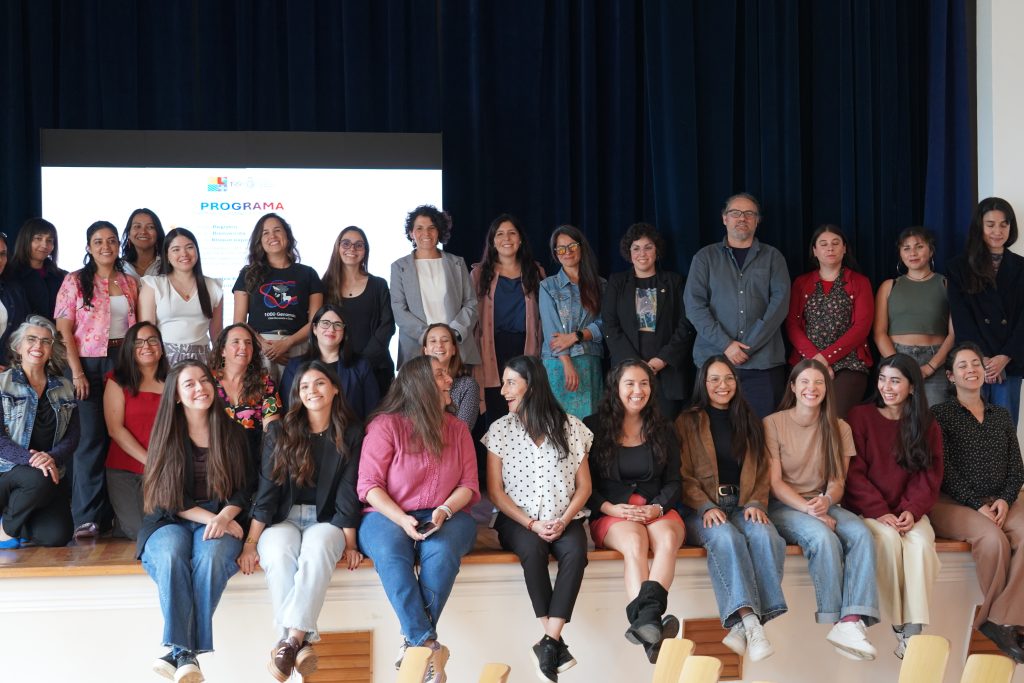
Photo: Millennium Institute BASE/Antonieta Mackenzie
Valparaíso
How do you build an outstanding scientific career as a woman living in the regions? With this question in mind, the Millennium Institute Center for Genome Regulation (CRG), the 1000 Genomas initiative and the Pontificia Universidad Católica de Valparaíso (PUCV) held the seminar “Women and the regions do science”.
Held at PUCV’s Casa Central, the event brought together women researchers from Antofagasta, Valparaíso, O’Higgins, Biobío, La Araucanía, Los Ríos and Magallanes. Its aim was to highlight careers developed outside the country’s political centre, examining the challenges and lessons of doing science with a strong territorial identity.
Women’s leadership and institutional excellence
PUCV’s Vice-Rector for Research, Creation and Innovation, Luis Mercado, highlighted the university’s role in overcoming historical gaps:
“As we approach our centenary, PUCV is leading national scientific development by overcoming gender gaps. Our strategic competitiveness allows us to advance initiatives in which women’s leadership is central, such as Science Up and INES Innovation and Gender.”
For his part, CRG Director Miguel Allende emphasised the importance of decentralisation:
“This meeting allows us to connect frontier research with society, highlighting the role of women who make significant contributions to the country’s technological development from the regions.”
The challenge of the ‘scissors effect’ in the regions
Doing science in the regions involves overcoming structural barriers: limited access to funding, infrastructure and professional networks. Added to this is the fact that, although women account for more than 50% of university enrolment in Chile, their representation falls sharply at advanced stages of a scientific career, a phenomenon known as the ‘scissors effect’.
To address this situation, CRG Deputy Director Juliana Vianna stressed the urgency of building territorial networks:
“When we connect experiences from Antofagasta to Magallanes, we do more than share challenges: we generate collective solutions. Strengthening science with a gender perspective means transforming research conditions and showing that science with a global impact can be done from any region.”
Inspiration and international reach
The programme included testimony from PUCV School of Agronomy academic and CRG researcher Romina Pedreschi, who urged new generations to persevere:
“A lack of resources does not define your ability; your perseverance and talent do. It is possible to produce science with a global impact from the regions.”
The event concluded by reaffirming the organising institutions’ commitment to consolidating a scientific ecosystem in which regional knowledge is valued not only for its local relevance, but also for its contribution to the global challenges of the 21st century.