Colegual rural school students discover the forest’s DNA at the “Science in Your Hands” workshop in Frutillar’s Science and Nature Biopark
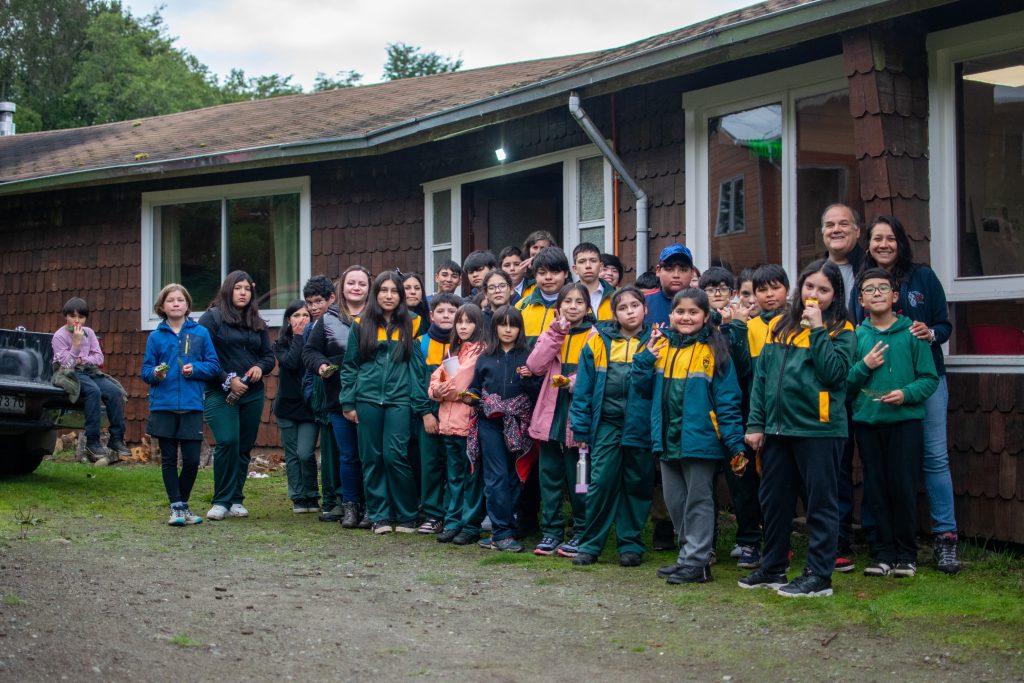
At the heart of Universidad de Chile’s Frutillar Experimental Station, science became a tangible experience rather than an abstract idea. Fifth- through eighth-grade students from Escuela Rural de Colegual joined the “Science in Your Hands” workshop, becoming scientists for a day as they explored the secrets of DNA and native forest biodiversity.
The activity took place at the Science and Nature Biopark, a project led by Universidad de Chile’s Faculty of Forestry and Nature Conservation. It aims to open the experimental station to the community and turn it into a living laboratory for science education and conservation.
During the workshop, students extracted DNA from fruit, following experimental protocols that allowed them to make the invisible visible. Using simple materials and techniques employed in molecular biology laboratories, the children observed how DNA—the molecule containing the instructions for life—can be isolated and seen with the naked eye.
The day continued with a paper chromatography activity in which students separated pigments from native forest leaves. The experiment revealed the hidden colors of plants, showing that behind their green appearance are different pigments involved in fundamental processes such as photosynthesis.
The workshop also featured Chilean startup Australis Biotech, which introduced environmental DNA, an innovative scientific tool for detecting species in an ecosystem through genetic traces in water, soil or air.
The experience ended with a walk along the experimental station’s native forest trail. Students connected what they had learned in the laboratory with the natural heritage around them, understanding how science helps us study, understand and protect ecosystems.
The initiative was coordinated by the Millennium Institute Center for Genome Regulation (CRG) through its 1000 Genomas Chile program, in collaboration with the Allende-Connelly Foundation and with support from the Chilean Academy of Sciences.
Activities such as “Science in Your Hands” seek to bring scientific research to new generations, demonstrating that genetics, biodiversity and conservation can be studied not only in sophisticated laboratories but also through direct contact with nature.
In a country known for its extraordinary diversity of ecosystems, science education initiatives like this help children understand that the forest also holds genetic information, and that learning to read it is one of the keys to addressing climate change and biodiversity conservation.