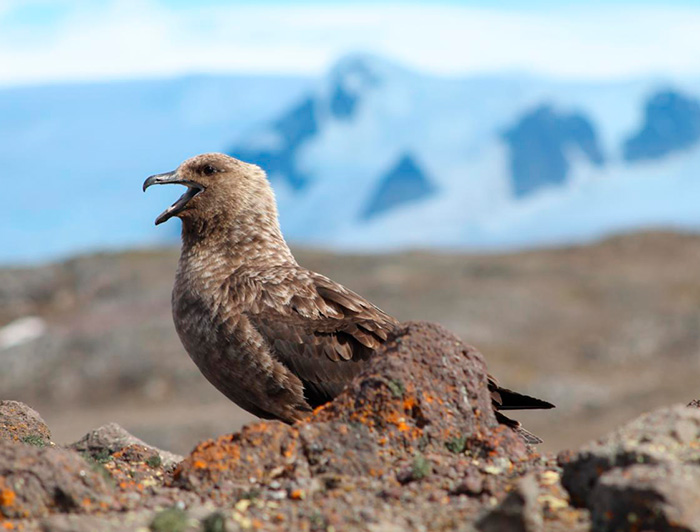
How does genetics help skuas adapt to Antarctica?
A study of three predatory seabird species led by Dr. Juliana Vianna, deputy director of the Millennium Institute CRG and a Millennium Institute BASE researcher, reveals that, unlike pure populations, hybrid individuals show greater genetic diversity and genes promoting physiological adaptation to low temperatures.
Three Southern Hemisphere seabird species are adapting to Antarctica’s extreme environments through genetic introgression, an evolutionary process in which genes pass from one species into another through hybridization.
This is the finding of a study published in Molecular Biology and Evolution and led by Faculty of Biological Sciences academic Juliana Vianna, deputy director of the Millennium Institute Center for Genome Regulation (IM-CRG) and researcher at the Millennium Institute BASE. Conducted with thesis students Josefina Jorquera and Lucila Morales, the work forms part of a project funded by the Chilean Antarctic Institute (INACH).
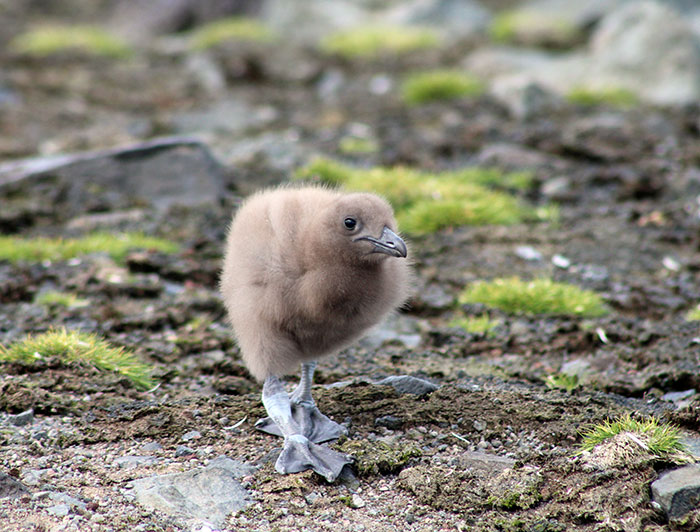
The research focuses on three skua species, predatory seabirds: the Chilean skua (Stercorarius chilensis), found in Chile, Argentina and the Falkland Islands/Islas Malvinas; the south polar skua (S. maccormicki), distributed around Antarctica; and the brown skua (S. antarcticus), found on the Antarctic Peninsula and sub-Antarctic islands.
Using high-coverage genome sequencing of more than 100 individuals collected from South America to Antarctica, the team reconstructed the species’ evolutionary history, identified patterns of genetic mixing, and discovered signals of adaptation to polar climates.
Introgression: a route to adaptation
The research documents geographic areas where these species interbreed and produce hybrid offspring, particularly from the Antarctic Peninsula to sub-Antarctic Bouvet Island. In these hybrids, scientists detected genes associated with functions essential for surviving cold climates, including lipid metabolism, thermal regulation and reproduction.
The results suggest that genetic introgression plays an important role in these birds’ ability to adapt and expand into new environments, especially amid climate change. Unlike pure populations, hybrid individuals showed greater genetic diversity and genes favoring physiological adaptation to low temperatures.
Projections under climate change
The authors also developed ecological distribution models for different future climate scenarios. The results indicate that hybrid populations could expand their Antarctic range by 2100, while some non-hybrid populations, such as the Chilean skua, could become less widespread in southernmost South America.
The work highlights hybridization as an important evolutionary mechanism, especially where species boundaries overlap and environmental conditions are changing rapidly. It also reinforces the value of large-scale genomic studies for understanding biological adaptation.
“(…) Studying these mechanisms is essential not only to understand how species respond to new challenges, but also to anticipate which lineages have greater genetic resilience to persist in future ecosystems.” — Juliana Vianna, UC Biological Sciences academic and CRG deputy director.
Evolutionary convergence
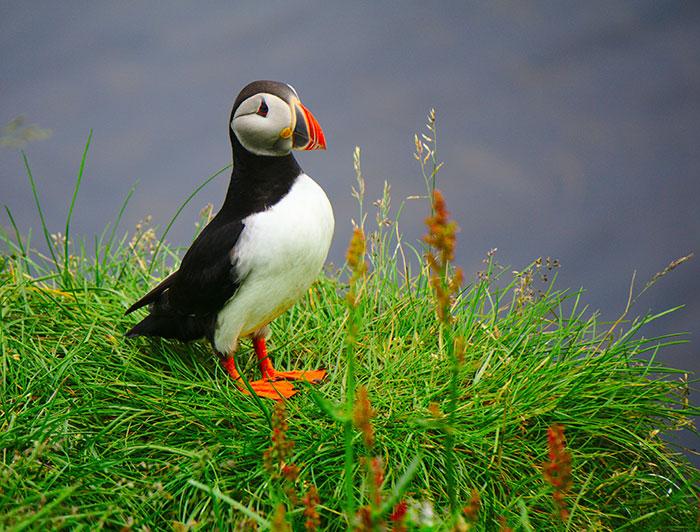
Four other skua species breed in the Arctic and are being studied for comparison with the three Antarctic species already investigated. Researchers are also comparing convergent adaptations in Arctic birds of the Alcidae family, including auks and puffins, with penguins in the Southern Ocean.
The research was coordinated by Chilean institutions, including academics from Pontificia Universidad Católica de Chile, Universidad Andrés Bello and the Millennium Institutes BASE and CRG, together with research centers in Australia, Europe and South Africa.
Juliana Vianna explains: “What is fascinating about this study is that it reveals how evolution does not always proceed linearly or in isolation. Through genetic introgression—the incorporation of genes from one species into another through hybridization—we see skuas gaining key adaptive tools for survival in extreme polar environments. Genes related to lipid metabolism, thermal regulation or reproduction do not appear at random: they are being selected because they confer a specific physiological advantage against the cold.”
“From a molecular biology perspective, these results offer a window onto adaptation over short evolutionary timescales. Hybridization, long considered an anomaly, is now understood as an evolutionary driver. Amid accelerating climate change, studying these mechanisms is essential not only to understand how species respond to new challenges, but also to anticipate which lineages have greater genetic resilience to persist in future ecosystems,” she concludes.