
Gentoo penguin DNA reveals how the Southern Ocean is shaping their evolution—and why they are not all alike
A recent large-scale genomic study shows that what we considered “one species” may actually comprise four distinct lineages, each adapted to its own environment. The research has direct implications for their conservation under climate change.
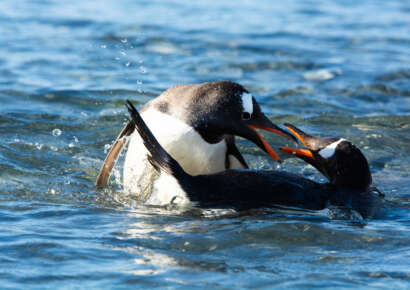
For more than a century, gentoo penguins were treated as a single species distributed throughout the Southern Ocean. A new study challenges that view. An international team involving Universidad de Los Lagos, Universidad Andrés Bello, the Millennium Institutes CRG and BASE, and Universidad de Chile, in association with the University of California, Berkeley, analyzed complete genomes from 64 individuals in ten Southern Hemisphere colonies, from the Falkland Islands to areas near Antarctica, including Kerguelen, Crozet and Macquarie islands. Their findings transform our understanding of these birds: DNA reveals four deeply divergent lineages, each with distinctive genetic signatures reflecting adaptation to its environment and representing advanced stages of speciation.
The Southern Ocean, which surrounds Antarctica, is far from homogeneous. Temperature, sea-ice cover, salinity and food availability vary enormously between areas. Over millions of years, these environmental differences left a “mark” in the DNA of penguins inhabiting each region. “The environment is not merely the setting where organisms live; it is also a force shaping their DNA over time, leaving traces in their genomes,” says study author Dr. Daly Noll, a Universidad de Los Lagos academic and affiliated researcher at the Millennium Institutes BASE and CRG.
“In the Southern Ocean, these environmental differences have driven gentoo penguins along distinct, independent evolutionary paths, demonstrating a process of speciation,” says the researcher, who holds a doctorate in Ecology and Evolution.
The differences are not everywhere in the DNA, but in key regions
To obtain these results, researchers processed more than nine million genetic variants. The differences are not random, they emphasize. The most significant divergences occur in genomic regions associated with key functions such as body-temperature regulation, energy metabolism and communication.
Communication was among the most unexpected findings: several groups show changes in genes related to vocal learning, suggesting that differences in vocalizations could contribute to reproductive isolation.
“In this research, we were able to delimit the four gentoo penguin species and provide a complete formal description of one, using genomic data alongside several other approaches,” says Dr. Juliana Vianna, a UNAB academic and deputy director of the Millennium Institute CRG. “Our study also uses future species-distribution models under climate change, and we found that each will respond differently, with some more threatened than others,” adds the Millennium Institute BASE researcher.
The genetic differences between the four groups are comparable in magnitude to those observed between birds already recognized as separate species. The study therefore proposes treating these lineages as four independent species, supported by genomic, morphological and ecological evidence. One—the gentoo penguin of the Kerguelen Islands—is formally described as a species new to science.
A warning for climate change
The finding extends beyond taxonomy, the international teams emphasize. “Until now, all gentoo penguins were assessed as a single conservation unit, numerically dominated by the Antarctic Peninsula group. This left the other, much smaller and more vulnerable groups invisible in global records,” they explain.
The study’s projections show that under expected climate scenarios for 2050, three of the four groups could lose a substantial share of their marine habitat. “Some are already declining: monitored colonies on Macquarie Island have lost 50% of their breeding pairs over the last three generations,” the team notes.
“This study shows that even well-known organisms can contain unrecognized biological diversity, and correctly identifying it is fundamental to any serious conservation assessment,” concludes Dr. Elie Poulin, a Universidad de Chile academic and director of the Millennium Institute BASE.
Because they are adapted to different environments, these groups will not respond equally to climate change. Recognizing them as separate entities is therefore a practical necessity for their protection, the researchers explain.
The international research also demonstrates the power of next-generation genomics applied to ecological and evolutionary questions. High-throughput sequencing made it possible to reconstruct these birds’ evolutionary history at previously unattainable resolution and connect it to the environment that shaped it. “It is not just about reading DNA, but knowing where to look,” says Dr. Daly Noll. “Genomics allows us to identify precisely which genomic regions contribute to divergence between lineages and how they reflect adaptation to different environments.”
The study involved the Millennium Institutes Center for Genome Regulation (CRG) and Biodiversity of Antarctic and Subantarctic Ecosystems (BASE), Universidad de Los Lagos and Universidad de Chile, alongside institutions in Australia, the United Kingdom, France, South Africa, Argentina, Spain, Monaco, Venezuela and the United States. It also forms part of Daly Noll’s doctoral thesis in Universidad de Chile’s PhD in Sciences program, specializing in Ecology and Evolutionary Biology, co-supervised by Dr. Juliana Vianna and Dr. Elie Poulin, and an ANID Fondecyt Postdoctoral project.
Paper: https://www.nature.com/articles/s42003-026-10081-7
Press release: Millennium Institutes CRG and BASE