
Extreme viruses: the invisible guardians of El Tatio’s geysers
At El Tatio’s geysers, viruses are guardians of microbial life and hidden drivers of evolution in some of Earth’s most extreme environments
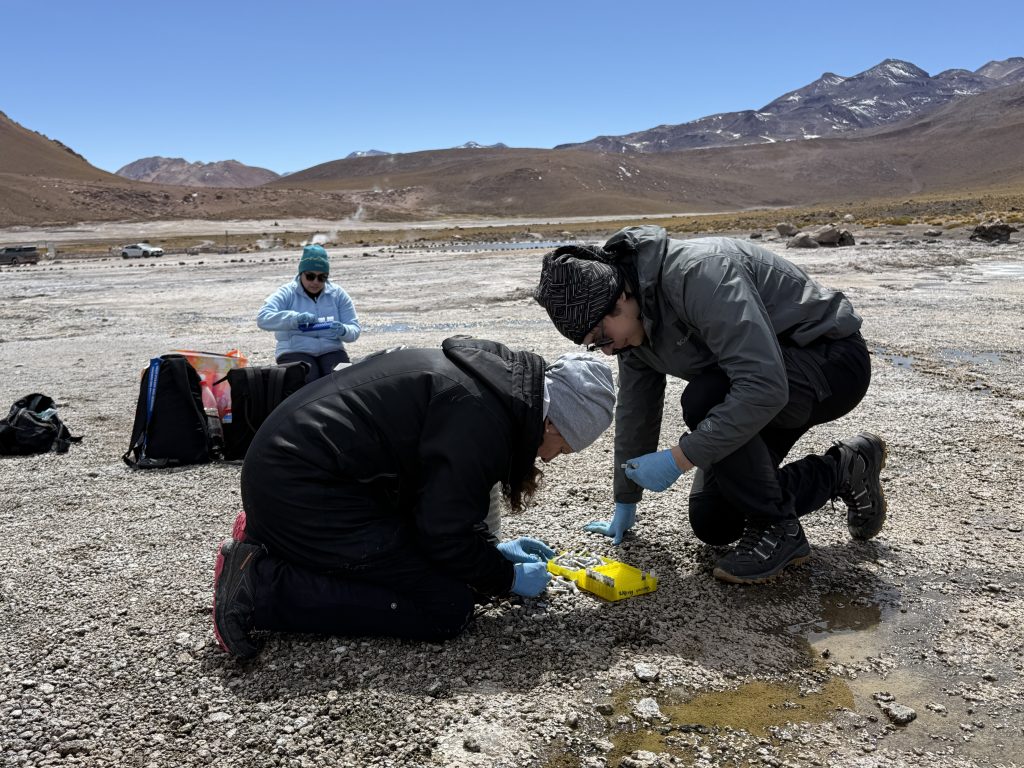
At an altitude of 4,300 meters, El Tatio’s geysers release columns of steam across one of the planet’s most inhospitable yet mesmerizing landscapes. Air temperatures fall below freezing within hours, ultraviolet radiation burns within minutes, and the ground is saturated with salts. Yet hot springs emerge from below, forming islands of color and life on the altiplano.
Every organism inhabiting these springs carries a quiet history of adaptation: generations of microorganisms that adjusted their biology to tolerate conditions lethal to most living things. The protagonists are not animals or plants, but entities most people associate with flu and pandemics: viruses. Here, however, they do not make people ill. Instead, they may be among the forces driving adaptation and sustaining life where almost nothing should exist.
More than enemies: a reputation science is rewriting
Few biological entities are as misunderstood as viruses. Since the 20th century, and with renewed force after COVID-19, humanity has learned to associate them with threats and disease. That narrative makes sense in medicine, but represents only a tiny fraction of what viruses do on Earth.
Beyond human, animal and plant bodies lies a universe of environmental viruses that infect not people but microorganisms: bacteria, archaea, protists and fungi. When a virus infects and destroys a bacterium in soil or seawater, it is not causing a human disease; it is actively participating in ecosystem functioning. Microbial ecology is revealing that these viruses often play central regulatory roles in the microbial communities sustaining life on Earth.
“Where there are microorganisms, there are viruses. And where there are viruses, their role is likely to be important.”
The viral shunt: a lesson from the ocean
Environmental viruses have been studied most extensively in the sea, with revolutionary findings. Whenever a virus destroys an ocean bacterium, it releases cellular contents—carbon, nitrogen and phosphorus—back into the system. This “viral shunt” is forced recycling: nutrients that would otherwise remain inaccessible return to circulation for other organisms. Recent work, including Abbasi and Alam (2025), also documents how this mechanism influences the global carbon cycle, affecting how much CO₂ remains dissolved in seawater and how much reaches the atmosphere. Marine viruses, in other words, have a say in the planet’s climate.
Viruses also facilitate genetic exchange between bacteria, accelerating their ability to adapt to changing conditions. An inevitable question follows: what happens in even more extreme aquatic ecosystems?
El Tatio as a natural laboratory
El Tatio’s aquatic ecosystem combines formidable biological challenges: intense UV radiation, extreme temperatures, high salt concentrations and very little rainfall. Nevertheless, microbial communities thrive there.
What remains unknown is how viruses function in this setting. Geographic isolation and environmental selection pressures may have produced unique viral communities with possible local endemism—viruses found nowhere else on Earth. These are the questions investigated by Dr. Díez’s laboratory at Universidad Mayor, with ANID-Fondecyt funding (1230217) and through her role as a Center for Genome Regulation researcher. The work examines viral dispersal, prevalence and functions in host adaptation and evolution at El Tatio.
Why it matters beyond the desert
Studying El Tatio’s viruses is more than academic curiosity. Climate change is making vast regions more arid and extreme. Understanding how life works where extremes are already normal is a practical way to prepare. If viruses stabilize microbial communities under harsh conditions, their presence or absence could determine whether an ecosystem retains its functionality or collapses. Their roles in nutrient recycling and gene transfer under extreme stress could also inspire ecological restoration strategies for areas affected by desertification or pollution.
There is an astrobiological dimension too: Atacama conditions are considered terrestrial analogues of planetary environments, particularly Mars. If viruses thrive and perform ecological functions under such extremes, this broadens our understanding of where life might exist and reminds us that its simplest forms find pathways we do not see.
A methodological frontier
The field’s greatest challenge is technical. Viruses are difficult to extract and characterize: their particles occur at lower concentrations than those of their hosts, their genetic material is more fragile, and they cannot be cultured without the cells they infect. Standard techniques simply do not work for them.
Metagenomics is changing that. It allows all genetic material in an environmental sample to be sequenced without culturing, enabling complete viral genomes to be reconstructed, probable hosts identified and functions inferred. It is like reading a play’s script without seeing it performed—but the script already tells us a great deal. Ongoing research at El Tatio seeks to determine whether viruses act as ecological stabilizers and drivers of microbial adaptation, or whether this high-temperature environment has generated previously unknown viral strategies.
From fear to admiration
The most urgent change biology—and society—needs is conceptual, not technological. Viruses are not only enemies. At El Tatio’s geysers, they may be building, regulating and adapting: invisible architects of a microscopic community that, against the odds, clings to life and evolves under extreme conditions.
Studying them means understanding the limits of what is possible. In the Atacama, those limits are much wider than we imagine.
Viruses that do not make humans ill may quietly sustain life in Earth’s most hostile places, including those with extremely high temperatures.
By Milena Murillo
CRG Communications Director
Edited by Beatriz Díez Moreno — Principal Investigator, CRG