How can we protect what we do not understand? Bringing genomics to the heart of Chilean biodiversity
Imagine a country where the Andes meet the world’s driest desert, where southern glaciers coexist with ancient forests and coasts teeming with marine life. Chile is that place: a living laboratory of biodiversity. But how can we understand and protect this biological richness if the science studying it never leaves the laboratory or speaks with the people who live alongside it every day?
This is where biodiversity genomics can contribute. In this field, we read the DNA of plants, animals, fungi and microorganisms to understand how they evolve, adapt to their environments and interact with other organisms. This powerful tool lets us observe the invisible, unraveling genetic stories that reveal everything from unique survival strategies to clues about climate change’s effects.
For that information to have a social impact, however, we need more than data: we need dialogue. We need committed science outreach rooted in local communities.
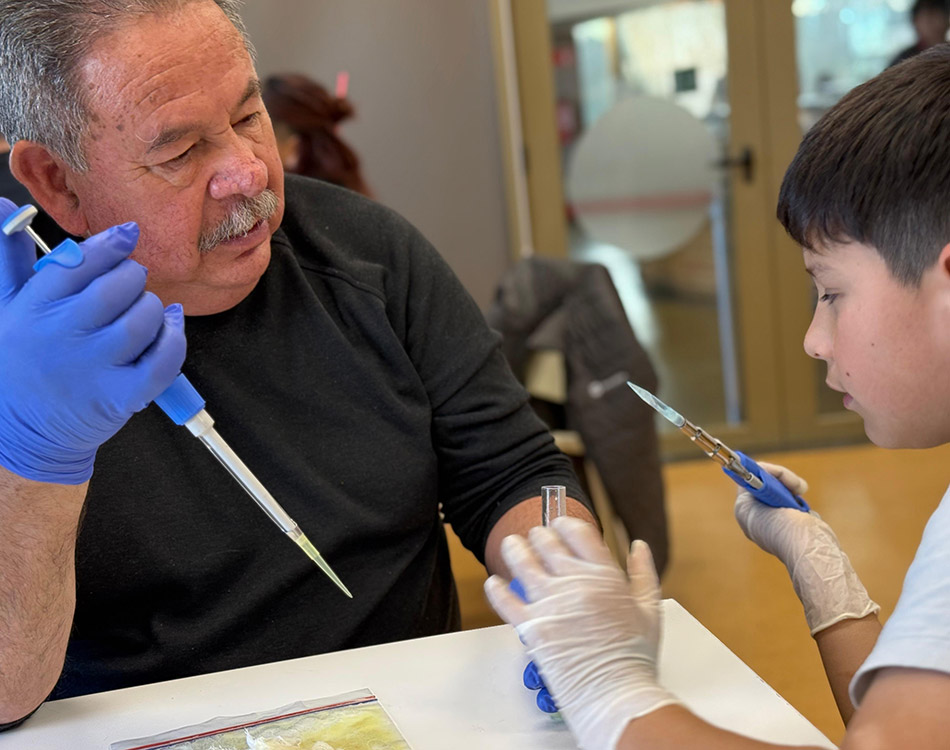
At the Millennium Institute Center for Genome Regulation (IM-CRG), we have embraced the challenge of democratizing genomic science. For years, we have taken science beyond its walls into schools, public squares, fairs, museums, hills, islands and coasts. We create experiences that do more than inform: they connect, move and transform people.
Science that is experienced, science that stays with us
We have held school workshops in Santiago where children can see and touch DNA, and public fairs in northern Chile where more than 2,000 people have gathered to discuss science, biodiversity and their surroundings. We have reached school communities on Rapa Nui, where scientific knowledge intertwines with local knowledge—not by imposing truths but by opening spaces for shared reflection.
“Bringing genomics to island communities such as Rapa Nui is not just transferring knowledge; it is building bridges between science and ancestral knowledge for more effective, culturally relevant conservation,” explains Juliana Vianna, a researcher at UC’s Faculty of Sciences and deputy director of IM-CRG.
From genomic analysis of endemic species to co-creating educational materials, our work on Rapa Nui and in the Atacama Desert has been both scientific and community-centered. What transformed us was not only what we taught but what we learned: how to do science with others, not about others.
This approach has also taken shape in a children’s book designed to nurture curiosity from an early age: ADN Explorador: Preguntas y Respuestas para Pequeños Científicos (DNA Explorer: Questions and Answers for Young Scientists). The project has been so well received that new books are already in production for children in different regions of Chile.
Our work does not stop with childhood. We have also shown that scientific collaboration can cross generational and academic boundaries. One example is a paper co-authored with schoolchildren on the earwig genome—small insects often overlooked despite their important ecological role. https://biolres.biomedcentral.com/articles/10.1186/s40659-023-00414-9
The students did more than collect data: their questions guided the research. The publication, a pioneering milestone in Chile, is not only an academic achievement but a statement that science can also grow from children’s curiosity.
“Democratizing science does not mean simplifying it, but making it accessible without losing depth. Our aim is for every child, every older adult and every person in this country to feel that genomics belongs to them too,” says Miguel Allende, an academic and CRG director.
Science for every age
Older adults have historically been among the most overlooked audiences in science outreach. Yet we have rarely encountered people so wise, so eager to understand and share. Many have witnessed their landscapes change, species disappear from view, and quiet transformations that science now seeks to explain.
When we talk to them about DNA, they do not think of test tubes: they think of birds that no longer sing in their towns, drought that has come to stay, and trees that once provided shade. Genomics then becomes a tool for memory, recovery and intergenerational connection.
That is why our activities seek to reach them too. Science has no age limit. And if biodiversity genomics is to have a real impact, we must speak to everyone—from the curious child to the grandmother who remembers her hillside before mining.
Why do we communicate science?
Because publishing in indexed journals is not enough if local people do not know the value of their biodiversity. Because we need citizens who understand what is at stake. Because science can become action only when it is experienced and discussed within communities.
Now more than ever, bringing science to local communities is neither a luxury nor a symbolic gesture. It is an urgent necessity. Science must not remain archived in papers that not everyone reads, or be sold as a fleeting fairground experience without context. It must be understood, felt, discussed and built with and for society.
Only by connecting knowledge, emotions and local realities can we build meaningful science: science that empowers communities, preserves our unique biodiversity and ultimately transforms our collective future.