Pioneering research discovers new viruses that could affect the Antarctic food web
- A scientific team led by Dr. Beatriz Díez, a researcher at the Millennium Institute Center for Genome Regulation (IM-CRG), identified more than 2,400 new viral genomes in Antarctica, including giant viruses and bacteriophages. Conducted in Chile Bay, the study shows how the microbiome regulates the food web and could be affected by global warming.
Santiago, May 22, 2025. More than a decade of work in the Southern Ocean has enabled the team led by Dr. Beatriz Díez, a Universidad Mayor academic and Millennium Institute Center for Genome Regulation (IM-CRG) researcher, to advance understanding of the Antarctic marine microbiome.
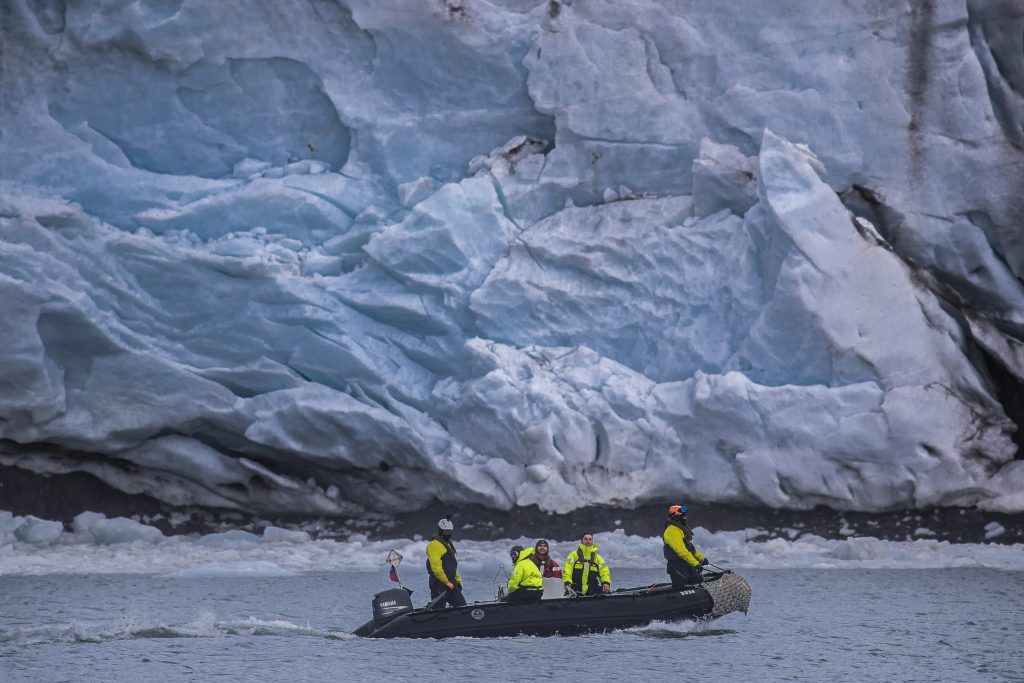
Their latest study, conducted in Chile Bay on the Antarctic Peninsula as part of the National Antarctic Science Program (PROCIEN) and expeditions organized by the Chilean Antarctic Institute (INACH), revealed thousands of previously unknown viral genomes. The findings highlight viruses’ unique adaptations to extreme cold and their impact on this polar ecosystem’s food web. “These findings are key to understanding how climate change could affect one of the planet’s most fragile and fundamental ecosystems,” Díez said.
Conducted in one of the world’s most extreme environments, the research provides new evidence of marine viruses’ crucial role in nutrient cycles and polar ecosystem stability. Viruses infecting phytoplankton and bacterioplankton directly influence ocean primary producers and therefore affect the entire food web supporting krill, fish, birds and marine mammals such as seals and whales.
Previously unknown viral diversity
The study identified more than 2,400 new viral genomes, including giant viruses and bacteriophages, significantly advancing knowledge of genetic diversity and viral endemism in the Southern Ocean.
Researchers also detected viral proteins with structural modifications enabling them to function below freezing, demonstrating adaptation and survival under extreme conditions.
They confirmed that these viruses facilitate horizontal gene transfer, promoting the evolution and adaptation of local microbial communities and strengthening their resilience to environmental change.
The findings also demonstrate viruses’ crucial role in regulating bacterial and phytoplankton abundance, with large-scale effects throughout the Antarctic marine ecosystem. “Plankton forms the base of Antarctica’s food chain, but its relationship with viruses is what truly determines this ecosystem’s health and stability,” Díez says.
The team warns that climate change is altering environmental conditions on the Antarctic Peninsula, one of the fastest-warming areas on Earth. This could change phytoplankton composition, affecting all Antarctic animals dependent on these microalgae.
The study consolidates the Chile Bay Marine Observatory as a reference point for polar microbial biodiversity research, providing essential information for anticipating climate change’s impacts on the ocean and global climate regulation. Antarctica, which absorbs around 20% of the planet’s CO₂, plays a strategic role as a carbon sink, with its marine microbiome fundamental to this process.
“Understanding and protecting microbial biodiversity is essential for the future of the planet’s climate balance,” the researcher concludes.
INACH is a technical body of the Ministry of Foreign Affairs with full autonomy in scientific, technological and outreach matters concerning Antarctica. It implements the National Antarctic Policy by promoting research excellence, actively participating in the Antarctic Treaty System and related forums, strengthening Magallanes as a gateway to the White Continent, and sharing Antarctic knowledge with the public. INACH organizes the National Antarctic Science Program (PROCIEN).