Pozo Almonte students investigate the desert’s past to understand future climate in an innovative genomics and biodiversity workshop
Tarapacá Region, November 2025
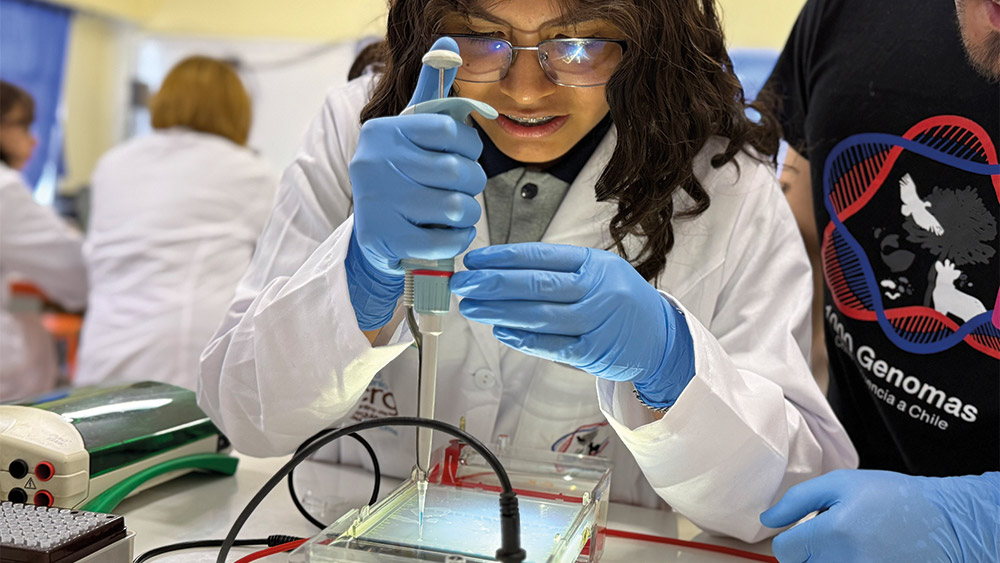
The Millennium Institute Center for Genome Regulation (IM-CRG) and 1000 Genomas Chile, supported by Tarapacá’s regional Science and Education secretariats, held the school workshop “Desert Explorers: Genomics and Biodiversity of Tillandsia Communities.” This locally rooted experience connected students with frontier research in one of the planet’s most extreme ecosystems.
Designed for seventh- and eighth-grade students alongside secondary school classes, the activity combined laboratory work and field observation to encourage scientific curiosity, strengthen analytical skills and introduce concepts such as climate, biodiversity and genomics. Students also encountered tools for evaluating the information they receive and understanding environmental phenomena through evidence.
The desert as an open book: a fossilized landscape tells its story
The field trip took place at Cerro Pajonales, where the desert functions as a vast “natural archive.” Students observed a fossilized landscape, ecological communities preserved through time, and the crucial influence of the camanchaca—the coastal fog that allows tillandsia communities, or “air plants,” to live with virtually no rain.
Researchers introduced key questions:
What happened in this desert thousands of years ago?
Why can these plants survive where almost nothing else can?
How do we know whether current changes reflect natural variability or human influence?
Students explored the hypothesis that the area once experienced colder temperatures and different atmospheric dynamics, allowing plant communities to form that are now relicts. They also learned that the camanchaca is rising in altitude, an indicator of environmental transformations that scientists study to anticipate future scenarios.
From past to future: science, genomics and mathematical models
During the workshop, students learned that studying past systems helps explain the present and predict future climate behavior. Researchers explained how genomics, together with mathematical models and bioinformatics tools, reconstructs the history of species adapted to the limits of aridity and projects their responses to climate change.
Researcher Claudio Latorre, who led the field activity, said:
“In places like Cerro Pajonales, the desert becomes a fossilized landscape preserving thousands of years of ecological history. When students observe these communities, shaped by the camanchaca and an atmosphere that was once colder and more dynamic, we invite them to formulate real hypotheses: what happened here? What was this environment like when these plants thrived? What is the current rise in cloud altitude telling us?
Studying past systems allows us to understand how natural systems function today. When we combine that history with genomics and mathematical models, we can project how this ecosystem will respond in the future. That is the science we aim to communicate: science that observes, interprets, anticipates and helps us prepare for the changes ahead.”
Tarapacá as a laboratory region for Chile
For Regional Science Secretary Ronald Yavar, these initiatives strengthen education and regional capabilities:
“Genomics, paleoclimatology and direct observation are extraordinary tools for young people to understand the place where they live. Activities like this inspire STEM careers, foster critical thinking and show that science helps us understand and care for our region in the face of climate change.”
Genomics and education: an alliance for the country
IM-CRG and 1000 Genomas Chile continue to promote science outreach across different regions, bringing studies of biodiversity, evolution and species adaptation to school and local communities.
This work seeks to democratize access to science, communicate scientific advances in accessible language, and provide practical tools for children and young people to analyze information, resist manipulation, understand environmental phenomena and make informed decisions.
Extreme ecosystems such as the tillandsia habitats of Pozo Almonte offer a unique opportunity to understand life at its limits, inspire scientific careers and educate new generations to meet Chile’s climate and environmental challenges.