
The hidden viruses of Chilean Patagonia
In some of the planet’s southernmost waters, a study reveals extraordinarily diverse, unknown viral communities with a surprising sensitivity to rising temperatures. The warning comes from the fjords of Chilean Patagonia.
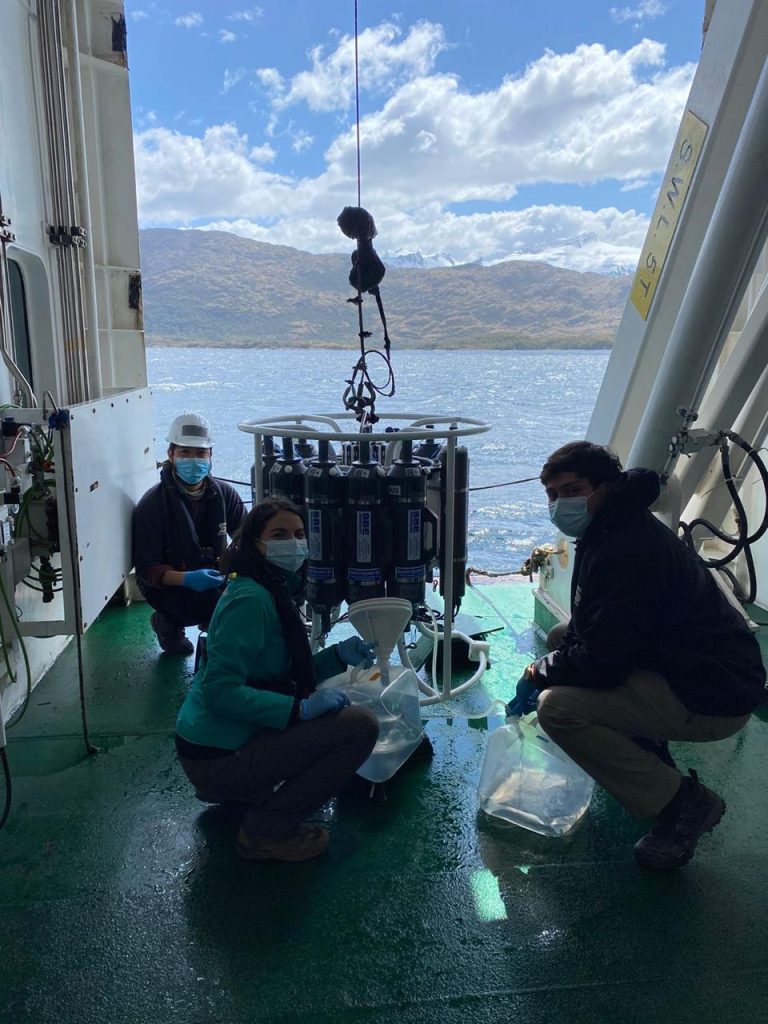
The invisible viruses sustaining Patagonian fjords are about to face their greatest challenge: heat
Sailing through Chilean Patagonia’s fjords means entering one of the planet’s most inhospitable and compelling landscapes. Between 41° and 55° south, where glaciers descend toward the sea and meltwater mixes with the Pacific, an invisible world has remained almost entirely unexplored: the marine virome of these sub-Antarctic waters.
A new study in Environmental Microbiome by Dr. Marianne Buscaglia and student Wilson Castillo from Dr. Beatriz Díez’s laboratory, together with Chilean and international collaborators, has changed that. What they found in these cold waters—and the warning it carries—should matter to us all.
A viral census at the edge of the world
During the southern spring of 2019, aboard the research vessel Cabo de Hornos, the team traveled more than 500 kilometers through Patagonian fjords, from Aysén to Magallanes. At 13 sampling stations, they collected seawater and processed it with painstaking care: successive filtration separated different particle sizes until viruses could be concentrated, followed by high-throughput viral DNA sequencing using shotgun metagenomics.
The result was an unprecedented inventory. Researchers identified 126 giant viruses, mostly affiliated with Prasinoviridae, which commonly infect phytoplankton, alongside more than 9,000 Caudoviricetes phages infecting bacteria and archaea. The most striking figure was not their number but their novelty: 94% of the giant viruses had no match in existing databases, highlighting the unexplored diversity of these organisms at high latitudes.
In other words, the region’s viral component remains largely unknown to science.
What exactly is a giant virus?
To understand the finding’s significance, it helps to examine one of the story’s less familiar protagonists: giant viruses, or Nucleocytoviricota.
Unlike the viruses we tend to imagine—tiny, simple particles that hijack cells to replicate—these viruses have unusually large genomes and particle sizes. They often encode auxiliary metabolic genes capable of altering host metabolism during infection, reprogramming photosynthesis, carbon metabolism and other key processes.
In Patagonian fjords, most giant viruses belonged to Prasinoviridae, known for infecting picoplanktonic green microalgae of the genera Bathycoccus, Micromonas and Ostreococcus. These photosynthetic organisms are so small that several thousand could fit inside the period at the end of this sentence, yet together they account for a substantial fraction of global ocean primary productivity.
The thermometer that organizes everything
Discovering thousands of unknown viruses is extraordinary in itself. But the next question was even more intriguing: what determines which viruses live where?
Researchers measured everything they could—water salinity, depth, oxygen and algal abundance—expecting some combination to explain the distribution patterns. The answer was surprisingly clear: water temperature explained almost everything.
Warmer waters in the northern transect contained more viral types and greater diversity. In the colder south, viral communities became less diverse and different in composition. Each degree of temperature seemed to act as an invisible filter determining who could live there.
Not only viral numbers but also the protagonists changed. Certain groups dominated the coldest waters; others appeared in temperate waters; and in the warmest waters, viruses infecting the green microalgae supporting much ocean productivity took over. Like a theater with a completely different cast depending on the season, the same setting changed under the influence of water temperature.
More than a thermometer: a mechanism
Why does temperature organize the viral world so decisively? The researchers propose several mechanisms operating simultaneously.
First, temperature affects viruses directly, changing degradation rates, infectivity and the dynamics of the lysogenic–lytic switch: whether a virus remains “dormant” within its host’s genome or actively triggers its destruction. Second, temperature acts indirectly by reshaping available host communities: without susceptible hosts, there are no viruses to infect them. Temperature can change both the composition and abundance of susceptible hosts, with cascading effects on viral community structure.
For viruses of prokaryotes—bacteria and archaea—salinity emerges as another important factor. This is consistent with salinity’s known effects on phage adsorption efficiency during infection. Marine bacteriophages also appear to require specific ionic conditions to maintain structural stability, because salt stress can affect capsid pressure. In Patagonia, where glacial melt and rivers create highly dynamic salinity gradients, this adds another layer of complexity.
A mirror of the climate future
This is where the study becomes most urgent.
Chilean Patagonia’s fjords are highly susceptible to climate change. Rising temperatures are expected to affect microbial and viral community dynamics, altering biogeochemical cycles, particularly carbon export. As a global CO₂ sink, Patagonia’s marine ecosystems perform a critical climatic function that we are only beginning to understand and quantify.
Viruses are not mere passengers in the ecosystem. Through infection and cell lysis, they redirect carbon and nutrients into the dissolved organic pool, influencing nutrient recycling and reducing trophic transfer efficiency. When a virus destroys a phytoplankton cell, its carbon does not move up the food chain: it disperses into the water as dissolved organic matter. This directly affects how much carbon reaches the deep ocean—and how much returns to the atmosphere.
If temperature is the main organizer of viral communities, and temperatures are changing in this region, the logic is straightforward: these communities are sensitive to environmental change, and their alteration could affect carbon cycling, nutrient regeneration and microbial food-web dynamics in Patagonia’s fjords.
What we still do not know
The authors carefully identify the study’s limitations and avenues for further work. Inorganic nutrient availability and sunlight—strongly seasonal factors in Patagonia—could also shape viral dynamics in ways not fully captured by a study focused on the southern spring.
The fundamental question of taxonomy also remains. A substantial proportion of both giant-virus and prokaryotic-virus sequences could not be classified at genus or species level, reflecting a broader challenge in viral taxonomy and the need to expand reference databases. In a sense, we still lack the vocabulary to name what we are finding.
A frontier deserving attention
The study by Dr. Díez’s laboratory and collaborators marks a turning point for marine virology in the Southern Hemisphere. For the first time, we have a broad, quantitative portrait of the viruses inhabiting the planet’s southernmost fjords and an initial understanding of the forces organizing them.
What these viruses tell us, through the impartial clarity of data, is that they are sensitive to temperature changes, and that regional warming may be decisive for their distribution.
On a warming planet, Patagonia’s fjords are more than a postcard landscape. They are a natural laboratory where climate change is first written in one of life’s oldest languages—DNA—and can be studied in the sea’s most abundant particles: viruses, which, although invisible, tirelessly shape the marine world.
In very simple terms…
Millions of invisible viruses live in Patagonian fjords and influence ocean health. For the first time, Chilean scientists conducted a census and discovered that most are completely unknown to science. Most importantly, they found that water temperature helps determine which viral types survive in each location. As climate change warms the ocean, these communities will change, affecting the carbon and nutrient cycles that sustain Patagonia’s marine ecosystem—one of the planet’s most important carbon-processing systems.
—
The study was funded by institutions including the Millennium Institute Center for Genome Regulation (ICN2021_044), the Chilean Antarctic Institute (INACH), and the Research Center for the Dynamics of High Latitude Marine Ecosystems (IDEAL).